
|
|
| Introduction | Links | Formats | Features |
| l | l | Media | Models |
|
DVD FORMATS
DVD-RAM and DVD-RW are the two official re-writable DVD formats. Both formats use phase change recording where the active layer is made to change between amorphous and crystalline state by means of a laser at different power. The differences between the two formats are shown in the table below.
As promising as DVD-RAM discs were in 1998, they never dominated, losing out to DVD-R and DVD-RW. Compatibility issues and higher cost kept the format from becoming as popular as the other recordable DVD formats. DVD-RAM discs use land/groove recording and Zoned CLV (ZCLV) method instead of CLV, where the angular velocity continuously changes. Within each zone the data is written/read using the CAV method, the angular velocity changing from zone to zone to maintain a constant average linear velocity. The data is written on both land and groove, the address information being moulded into the disc as pits. The current specification (version 2.1) is for 4.7GB or 9.4GB (double sided) capacity media (12 cm) which offer over 100,000 recording cycles and a 30-year life or more. In May 2019, Panasonic, the only remaining manufacturer of DVD-RAM discs, announced that it would end production of DVD-RAM media at the end of May. DVD-RW discs use groove recording offering a 4.7GB capacity per side and does not need a cartridge. It offers advantages over tape in life (videotape life is 15 to 20 years) and the ability to edit home movies. DVD-RW discs are designed to be compatible with existing players and drives. Discs are recordable over 1,000 times and they have the same optical properties as a DVD-9 disc. DVD-RW discs can be used for videotape replacement, video authoring and desktop PC backup. Consumer applications include video recording and home authoring. DVD-RW discs also offer CPRM copy protection and can include BCA serialization. DVD+RW is a re-writable format introduced in October 2001 by the DVD+RW Alliance (HP, Philips, Ricoh, Sony, Yamaha, Verbatim/Mitsubishi Chemical, Dell and Thomson). It is not supported by the DVD Forum. DVD+RW incorporates lossless linking technology, allowing the drive or video recorder to accurately stop and start the writing process, or to replace individual 32kB data blocks. Lossless linking improves compatibility, performance and ease of use. DVD+RW discs have a capacity of 4.7 GB and do not need a cartridge. They offer 1,000 re-writes. For PC applications, CAV (constant angular velocity) recording allowsle fast, random access reading of the disc. Multi-session writing, as for CD-R, allows users to add data at a later date. DVD+RW's defect management ensures that data is accurately written to and read from the disc. 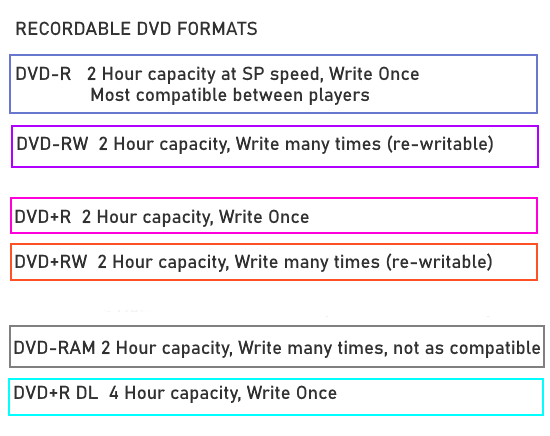 Columbia ISA Audio Video |
|||||||||||||||||||||||||||||||||||||||||||||