
|
|
DVD Introduction Audio Introduction TV Introduction DVD Sound CD Introduction Audio media DVD Audio |
|
Audio Media The difference between Sound and Audio Analog to Digital to Analog All sound we hear begins as analog when produced and ends as analog when played directly to us or played back to us from storage. The sound you hear with your ears is mechanical energy. It is mechanical because some physical moving thing has set off a vibration in a medium such as air. You cannot hear digital sound until converted to analog. Sound is the physical, acoustic vibrations that travel through a medium like air or water. Audio is the electronic or mechanical representation of that sound, today often stored as binary data or sent through cables or electronic circuits. If the sounds produced are stored for later playback, then the sound has to be recorded on some media. In the past, the analog sound was recorded on shellac, vinyl and magnetic tape. To the extent the media could store the sound accurately was the limiting factor as to the quality of the playback. There was no intentional alteration of the sounds except in the technological limitations of the processes of recording and playback. This is not the case with digital. Why is sound converted and stored as digital information? Because when sound is converted to digital, it can be stored on computers. When stored on computers, sound can be distributed from computer to computer over networks all over the world very quickly. Also when stored on computers, the sound can be compressed so it takes up less resources. The difference between analog and digital is that in analog, information is translated into electric pulses of varying amplitude. In digital, translation of information is into binary format, a format of zero or one, off or on. Digital Audio Files: Most modern media audio is recorded as digital files. These are commonly stored on physical media like Hard Disk Drives, Solid State Drives, SD Cards, and USB Flash Drives. 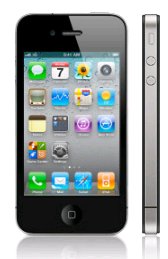 Optical Discs: CDs (Compact Discs), DVDs and MiniDisc store sound as microscopic digital pits read by a laser. Magnetic Tape: Once a standard for studio recording and home cassettes, magnetic tape (such as reel-to-reel tape or compact cassettes) records audio as variations in the magnetic field. 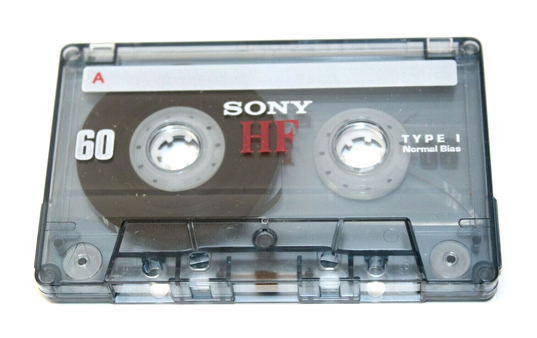 Audio Cassette Tape The standard audio cassette tape (C60) has 30 min. per side playing time at 1.875 inches per second, giving 1 hour of playing time. The C90 cassette provides 45 mins. per side or 1.5 hours. C90 tape is not as thick as C60 which allows more tape on the spools however it is more delicate. Shellac and Vinyl Records: Also known as phonograph records, these store audio as physical, analog grooves cut into a spinning disc, which a needle traces to playback the audio. 78 rpm, 45 rpm and 33 1/3 rpm records store audio for playback on a record player. Most records have two sides. The standard 10 inch 78 records have a 3 to 5 min. per side playing time. The 7 inch 45 records have 5 min. maximum per side playing time making an ideal single song media. Most songs are 3 to 4 mins. The 12 inch 33 1/3 records have about 20 mins. per side playing time. About 6 songs per side gives around 12 songs per record or around 40 mins. of total playing time. Wax Cylinders: the first commercially produced sound recording devices. 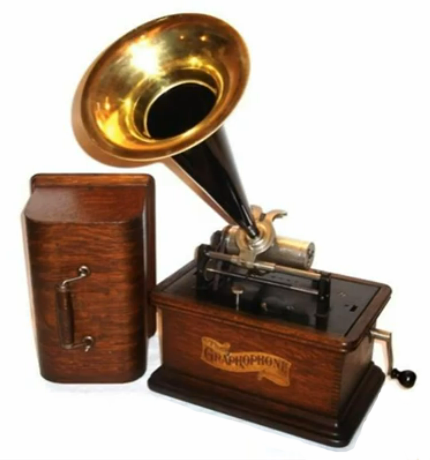 The first sound recordings were achieved by a French inventor Scott de Martinville in 1859 using his phonautograph device. In 1877 an American inventor Thomas Edison using his phonograph, recorded and played back voice. This was the first device to record sound and play back the sound recorded. A brass horn was used as the microphone to record and on playback was used as a speaker. Playing time was limited to just two minutes. Columbia ISA Audio Video Empowering consumers through information SWS |