
|
|
DVD Introduction Audio Introduction TV Introduction DVD Sound CD Introduction Audio media DVD Audio |
Super Audio CD SACD What is a Super Audio CD? Super Audio CD (SACD) is a high-resolution optical audio disc format introduced in 1999 by Sony and Philips as a superior-sounding successor to the standard Compact Disc (CD). It utilizes Direct Stream Digital (DSD) encoding, providing much higher sampling rates and wider dynamic range than traditional CDs. Super Audio CD (SACD) offers superior audio fidelity, multichannel surround sound, and higher resolution than standard Compact Discs (CDs) by utilizing Direct Stream Digital (DSD) encoding. While CDs use 16-bit PCM encoding, SACDs offer a 1-bit, 2822.4 kHz sampling rate, providing increased frequency response and dynamic range. Advantages of SACD over CD Multichannel Surround Sound SACD supports up to 5.1 channels, allowing for immersive audio, whereas CDs are limited to 2-channel stereo. Superior Resolution (DSD) Instead of standard PCM (Pulse Code Modulation) audio, SACD uses DSD encoding. This technology provides a much higher digital sampling rate, leading to greater sonic detail. Greater Dynamic Range & Frequency SACD offers a wider frequency range and greater dynamic range, capable of capturing more subtle nuances in the music. Hybrid Capability Many SACDs are "hybrid," featuring a high-resolution SACD layer and a standard CD layer that plays on any traditional CD player. Blu-ray players that play SACDs Blu-ray players offer one of the most popular and budget-friendly ways to listen to SACDs at home. Not all Blu-ray players are compatible with SACD playback. If you want one that's versatile enough to handle high-res video AND audio, make sure you choose an SACD-capable Blu-ray player. The Sony UBP-X700U is an example player. Sony - UBPX700U 4K Ultra HD Blu-ray Player Sony UBP-X800M2 4k Universal disc player SACD Disc Support Plays SACD, SACD/CD, and DSD discs. DSD File Playback: Plays 2.8 MHz DSD files via USB. Audio Output Options The player can output DSD directly via HDMI or convert DSD to PCM, allowing compatibility with most AVRs. Audio Video Receivers that can decode SACD DSD natively via HDMI include models from Denon, Marantz, Yamaha, and Sony. Key models often cited include the Sony STR-DH790, Sony AN1000, and various Denon X-series receivers, which can handle the DSD bitstream sent over HDMI from a compatible player. If not using HDMI, you will need a player with 5.1 analog outs and an older receiver with 5.1 analog inputs. SACD Playback: To hear the high-resolution SACD sound, you need a dedicated SACD player. Digital Output: Due to high bandwidth needs, digital output of SACD audio is usually handled via HDMI or specialized analog connections. Primary Connection Options Analog RCA (Stereo/Multichannel) Best for using the SACD player internal Digital to Analog Converter. Use dedicated 5.1/7.1 analog outputs for multichannel discs. HDMI The preferred digital method for modern systems. It allows transmission of DSD data to a compatible Audio Video Receiver or processor, supporting both high-res stereo and multichannel. Digital Limitations Coaxial/Optical digital audio (S/PDIF) outputs Typically cannot transmit the high-resolution DSD layer of an SACD due to copy protection regulations, downsampling the audio to 16-bit/44.1kHz (CD quality) or providing no audio at all. Copy Protection Sony mandates that digital outputs for SACD must be encrypted, which is why standard coaxial or optical cables generally do not work for full DSD output.
Do SACDs cost more than CDs? Yes, costs can be double. Do SACDs really sound better than CDs? They can, it depends on the mastering and the mix. Do SACDs sound better than vinyl? It is a matter of personal preference. Some prefer the warmth of analog sound from vinyl. Are old titles available on SACD? Yes, Dark side of the Moon (Pink Floyd), Johnny Cash, Simon and Garfunkel, The Eagles, Crosby, Stills and Nash, Supertramp, Fleetwood Mac, Dire Straits, Bob Dylan to name a few available but the catalog is much smaller than CDs. How do I connect my Bluray player with SACD support to my Audio Video Receiver for surround sound? Connect an HDMI cable from Bluray player HDMI output to A/V Receiver HDMI input. Switch AVR to correct source input. Go into your Blu-ray player's audio menu and select DSD mode, enable SACD output. The digital optical or coaxial audio connection will not work due to copyright restrictions and bandwidth limitations. Press the Home button on the player remote > Setup > Audio Settings > Digital Audio Output > 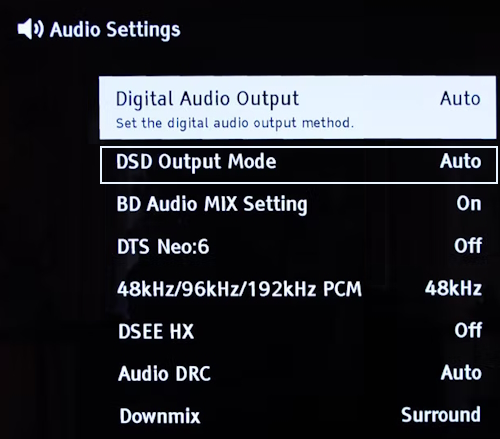 Columbia ISA Audio Video Empowering consumers through information SWS |