Digital Camcorders :
Mini-DV
Mini-DV
The most popular camcorder format is
very impressive with sharp, life-like video and CD
quality sound. MiniDV camcorders use a cassette smaller
than any analog size. A major advantage of the MiniDV
format is that since the tapes are very small - 1/12th
the size of a standard VHS tape - at 66x48x12.2mm - the
cameras that use it can be incredibly small
too.
Sony MiniDV camcorders record video using the digital DV format (IEC 61834), typically storing data at 720 x 480
pixels (NTSC) or 720 x 576 (PAL) resolution. One video channel and two independent audio channels are recorded in the digital format.
Standard Definition format for 525-60 and 625-50 systems.
Later models, branded as HDV, can record high-definition 1080i or 720p video onto the same tape using MPEG-2 compression.
Both use FireWire (i.LINK/IEEE 1394) to transfer digital data to personal computers with no analog conversion.
Sony MiniDV camcorders are designed to record, play, and transfer video in a digital format (DV),
but they include internal Digital-to-Analog Converters (DAC) to facilitate playback on analog equipment.
IEC 61834 is an international standard defining the recording format for helical-scan digital video cassette
systems using 6.35 mm (1/4 inch) magnetic tape, commonly known as consumer DV, MiniDV, and DVCPRO.
It specifies the content, data block format, recording methods, and electrical/mechanical characteristics to
ensure tape interchangeability across devices.
IEC 61834 (consumer Digital Video or "DV" format) is a compressed format.
It uses intra-frame Discrete Cosine Transform (DCT) compression, which compresses each frame individually
rather than using inter-frame compression like MPEG standards.
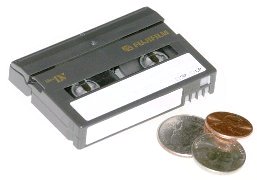
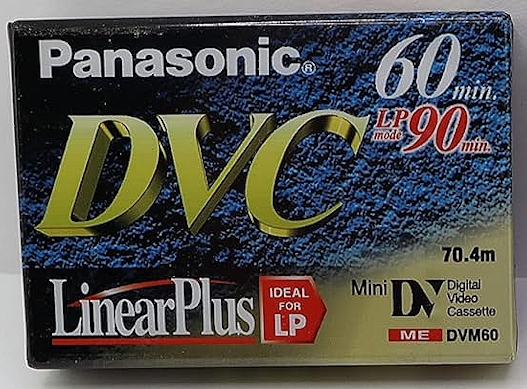
MiniDV cassette video tape
MiniDV can record an hour in standard format
or up to 90 minutes of lower quality output in LP (long
play) mode at horizontal resolutions of up to 500 lines.
The main controls of many MiniDV camcorders are accessed
not by the traditional menu thumbwheel, but by a
touch-screen LCD, which displays text icons which are
selected by literally touching them with fingers.
Compare the size of MiniDV with other
formats.
| Format |
Cassette L x W x
H |
Tape Width |
| MiniDV |
2.6 x 1.9 x 0.5
inches
(66 x 48 x 12.2 mm) |
1/4-inch
(6.35
mm) |
| 8mm & HI8 |
3.7 x 2.5 x 0.6
inches
(95 x 62.5 x 15 mm) |
Slightly less than
1/3-inch
(8 mm) |
| VHS &
S-VHS |
7.4 x 4.1 x .98
inches
(188 x 104 x 25 mm) |
1/2-inch
(12.7
mm) |
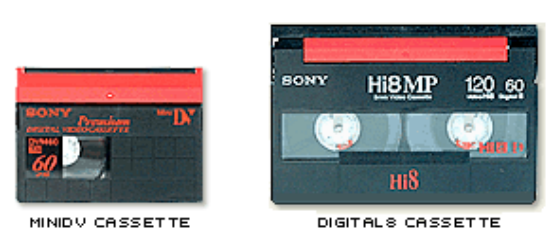
The MiniDV
cassette tape is just a fraction of the size of a VHS
tape and is also smaller than the 8mm, HI8, Digital8
cassette tape.

Camcorder MiniDV showing tape transport
The MiniDV camcorder functions like a small VCR, moving the video tape across the video heads from a supply reel onto a take-up reel, rewinding when finished. The cassette is inserted inside the tape transport and then pushed down. The camcorder handles the job of positioning the tape when you close the door on the side of the camcorder. The video tape has to be moved forward or backward, so access is sequential, unlike a DVD camcorder where access is dynamic, meaning you can go to any point on the disc without waiting for media movement.
For digital still pictures, a
memory chip can be used to store hundreds of images
until downloaded. Memory Stick is a format
for removable flash memory data storage devices, created
by Sony as an alternative to CompactFlash and SmartMedia
for use in their own devices. The original Memory Stick
interface can only address 128MB of memory physically.
This led to the introduction of Memory Stick PRO
with faster transfer speeds and a capacity of 256MB and
higher. There's also a Memory Stick Duo PRO with
the faster speed and higher capacity but the same
smaller form factor as Memory Stick Duo.
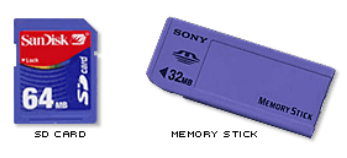
SD/MMC and Memory Stick
Many cassette-based camcorders incorporate an SD/MMC
or Memory Stick slot for the purpose of storing
digital still images and MPEG-1 or MPEG-4 video clips.
Camcorders save photographs in the compressed JPEG
format. For emailing and posting on the Web, MPEG-1 and
MPEG-4 formats are best. Like Webcams, some camcorders
can stream video in these formats directly to the
Web.
A few video cameras use these types of memory
exclusively to achieve an ultra compact design. Because
they record MPEG-1, MPEG-2 or MPEG-4 video only, they're
best suited for gadget lovers who want to use their
footage mainly on Web sites and in email. Camcorders
that record MPEG-2 or MPEG-4 to memory cards may be
picky about the cards you use, since those encoding
schemes require the ability to write to the card more
quickly than most standard cards can handle.
MiniDV Features
The on-screen user
interfaces offer great flexibility for setup and
control. The camcorders typically come with a charger
for the battery and AC adapter, software for video
transfers to a computer, large color LCD view screens,
powerful zoom, quality imaging devices and cables to
hookup to TV, VCR or DVD recorder. Using a IEEE-1394
cable or USB cable, video transfers to computer or DVD
are easily done. Today's camcorders come loaded
with features. Some are basic, like zoom, picture
stabilization, and titling. Others are more
sophisticated, like infrared video ability for night
shooting, and in-camera picture
effects.
MiniDV digital
recording delivers 3 times the color bandwidth of
VHS and a lower signal to noise ratio compared to
analog formats, providing stunning video
performance comparable to DVD. Lenses have an
advanced optical multi-layer coating offering less
glare and flare with increased contrast. This
results in vivid image brilliance, true-to-life
color saturation and perfect renditions of subtle
tones. Picture Stabilization controls a high range
of shake and vibration frequencies to achieve a
higher level of smoothness without degradation of
video.
The MPEG
movie mode lets you capture MPEG encoded video and
store it on memory chip media. Digital Still
memory mode allows you to capture 640 x 480
resolution or higher digital still images directly
onto memory chip media. Images are stored in the
JPEG format providing easy transfer to PCs for
emailing, printing, or sharing with family and
friends. This feature provides the dual function
of having one camera for video and still
images.
A USB
interface provides an easy way to connect your
Digital camcorder to your computer for fast and
easy transfer of your still images and MPEG
movies. The USB interface provides even bigger
benefits since it also allows USB streaming. This
feature allows you to stay connected with family
and friends by broadcasting live video with audio
via the Internet. You can even play back your
favorite recorded scene stored on tape. It's like
having a web camera and video conferencing system
built into your camcorder. With analog inputs and
Analog-to-Digital conversion you can convert
and/or record any analog NTSC video source to
digital video via the analog inputs. Analog NTSC
video can also be passed-through the digital
camcorder directly into a PC via the IEEE-1394
interface in real time for easy PC editing of your
analog footage.
With
some MiniDV camcorders you can capture video in
total darkness up to 10-20 feet away. The
Intelligent Accessory Shoe enables you to add
video lights and other intelligent accessories to
add even more performance.
The
swivel-screen LCD display provides excellent
viewing clarity. To give you a great view from
almost any angle, the LCD screen rotates up to 270
degrees. You can actually step away from the
camcorder and still monitor the recording, even
get in on the action yourself. The "On-Screen"
touch panel system allows you to navigate through
the camera's menu system quickly and easily at the
touch of the LCD screen. Color viewfinder is
typical and can be used in bright sunlight if
required.
Typically included extras: Power adapter/in camera
charger, rechargeable battery, wireless Remote
control, 2 AA batteries, A/V cable, lens cap,
shoulder strap, USB cable, LCD cleaning cloth,
CD-ROM with USB driver.
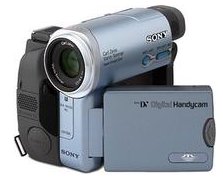
MemoryStick
PRO,
1/4 in. 680K pixel Advanced HAD™ CCD
with a Carl Zeiss™ lens, Firewire, USB and A/V in
out ports |

Sony |
Panasonic |
| 2003 Sony
DCR-TRV22 |
MiniDV
cassette |
60 min. (SP) 90 min. (LP) |
 |
 |
|
| 2006 Sony DCR-HC96 |
|
|

2005
Sony MiniDV DCR-PC55 and DCR-PC53
Camcorders
The world’s smallest and lightest
Handycam. The tiny Sony DCR-PC55 camcorder and its
sibling DCR-PC53 camcorder are scarcely larger than the
mini DV cassettes they use. Fully featured, they are
packed with innovative technology such as a 3.0-inch
Hybrid LCD monitor. Both launched in February
2005. The 3.0-inch LCD display also has a Touch Screen,
which can be used in conjunction with Sony’s Active
Menu, a logically structured graphical user interface
for camcorder control. With Memory Stick DUO you can
also easily shoot and store digital still images. Sony’s
Easy Handycam menu gives one-button access to basic
camera operation and recording settings. Both camcorders
feature a Carl Zeiss Vario-Tessar lens, with a 10X
Optical Zoom capability.

Panasonic PV-GS200 3CCD MiniDV
Camcorder
(March 2004)
A 3CCD
system uses an imaging system where the incoming light
is split into its red, green, and blue parts (RGB) and
captured on three separate CCD arrays. Each R/G/B signal
has a full pixel resolution, resulting in a horizontal
resolution three times higher than a typical camcorder's
single CCD.
Features:
- MiniDV camcorder with 3CCD optical system for
2.3MP resolution
- 10x optical zoom, 700x digital zoom
- 2.5-inch LCD
- Snap digital still photos and save to included
Secure Digital memory card
- Manual focusing ring, pop-up flash
- SanDisk 256 MB Secure Digital Card

2006 Panasonic PV-GS500 3CCD
MiniDV Camcorder
(April
2006)
The Panasonic PV-GS500 3CCD Digital
Palmcorder MultiCam Camcorder with 4.0 MP Still Picture
Recording offers superior images and features. This
small digital camcorder uses the same type of 3CCD
imaging system used in professional broadcast equipment,
giving you 540 lines of breathtaking resolution in a
more affordable package. The 4.0-megapixel still image
recording lets you record vivid, true-to-life pictures
with remarkable colors. And featuring a 12x optical
Leica lens with 700x digital zoom. Record to a miniDV
tape or directly to a PC through DV (FireWire) or
high-speed USB 2.0 interfaces, for high quality
full-motion video transfer. The color viewfinder and
2.7-inch LCD display make it easy to preview photos, and
feature navigation is a breeze with the easy, one-finger
joystick control.
Most professional
broadcasting cameras use the 3-CCD system. In a 1-CCD
system, all of the incoming light information is
processed by the same CCD. The more advanced 3CCD system
uses three distinct CCDs for processing, so there is
absolutely no light loss. You can see the results in
beautifully rendered images with vivid color, fine
detail, and rich gradation.
Video image quality - Superior
Battery life
- Superior (132 minutes)
Video recording media type -
MiniDV
Still image recoding media type - SD
Card
Still-image maximum resolution (megapixels) -
4.0
Image stabilization type - Optical
Viewfinder
type - Color
Inputs/outputs - FireWire, USB 2.0,
composite, S-Video, microphone
Weight (ounces) -
51
Dimensions (inches) - 2.9 by 3.6 by 6.0
 
2006 SONY DCR-HC36 MiniDV camcorder - Description
| Image device: |
1/6-inch CCD |
| Total pixels: |
680K pixels |
| Effective pixels: |
340K pixels (still), 340K pixels (video) |
| Recording media: |
MiniDV cassette, Memory Stick Duo, Memory
Stick PRO Duo |
| Memory Stick PRO compatibility: |
Up to 2 GB media capacity (high speed transfer
function/access control security function not
supported) |
| Recording/playback time: |
60 minutes (SP), 90 minutes (LP) |
| Video recording system: |
2 rotary heads, helical scanning system |
| Video signal: |
NTSC color, EIA standards |
| Still file format: |
JPEG |
| USB streaming: |
Yes |
| image stabilization: |
Yes (super, electronic) |
| Minimum illumination: |
5 Lux (0 Lux with Super NightShot Plus
infrared system) |
| Lens type: |
Carl Zeiss Vario-Tessar |
| Focal length: |
2.3 to 46 millimeters, 390 millimeters (tele
macro), equivalent to 48 to 960 millimeters (16:9
camera mode), 44 to 880 millimeters (4:3 camera
mode), 44 to 880 millimeters (4:3 memory mode) on
35-millimeter camera |
| Exposure: |
Touch panel (24 steps) |
| Filter diameter: |
25 millimeters |
| Focus: |
Full range auto, manual (touch panel) |
| Shutter speed: |
Auto, 1/2 to 1/4000 second (AE mode) |
| Zoom: |
20x optical zoom, 800x digital zoom |
| Interface: |
Analog AV output (multi AV), digital AV input
(via i.LINK), digital AV output (via i.LINK), USB
(1.1 compliant), i.LINK interface, S-video output
(optional accessory) |
| LCD: |
2.5-inch SwivelScreen LCD display, resolution
123K pixels |
| Viewfinder: |
Color (123K pixels) |
| Microphone: |
Built-in |
| Power supply: |
NP-FP30 battery pack (included), AC adapter
(included) |
| Software: |
Picture Package ver. 1.5 |
| OS compatibility: |
Windows Me, 2000 Professional, XP
Home/Professional |
| Dimensions (W x H x D): |
2.56 x 3.11 x 4.45 inches / 65 x 79 x 113
millimeters |
| Weight: |
15 ounces / 430 grams with tape and
battery |
| What's in the Box: |
DCR-HC36 MiniDV camcorder, AC-L25 power
adapter/in-camera charger, NP-FP30 rechargeable
battery, RMT-831 remote control, stereo AV cable,
lens cap, USB cable, CD-ROM (Picture Package
Software ver. 1.5, USB driver) |
| First released: |
2006 |

Canon ZR500 MiniDV Camcorder -
$399
Good, basic miniDV camera with 2.7" LCD,
Firewire 4 pin out. RCA out. Tapes load from the bottom
of the camera.

Canon ZR700 MiniDV Camcorder -
$499
Same as the ZR500 except adds analog
pass-through, a USB port, SD card slot and still picture
capability, plus a remote control.
What's In the Box:
Camera, battery, Power Adapter,
AV mini-jack to 3 RCA (video & audio) cable, remote
control, USB cable, and Mac/Windows software.
MiniDV
camcorders:
- Are available in compact
or standard-sized models — both are smaller than
Digital8
- Offer top-of-the-line
quality lenses
- Can give you the
benefits of digital video — like easy editing, digital
audio, and digital photo mode
- Offer a maximum record
time of 90 minutes in LP mode
• Which Camcorder Should I Buy?
• Digital
Camcorders - Digital8
• Digital
Camcorders - MiniDV
• MicroMV,
solid state memory cards
• Digital
Camcorders - DVD
• High-Definition
Camcorders
• Digital
Camcorders - Hard Disk Drive (HDD)
• Camcorder
Connections and Accessories
• Summary
|