Models
: Camcorder
Formats : Media
: Camcorder
Features
Camcorders
High Definition Camcorders - HDV
High Definition video is more popular as the flat panel HDTV displays become more affordable.
Prices have been coming down and consumers are beginning to think about recording their video in the crisp, sharp higher resolutions of HD rather than the traditional SD or standard definition. The SD resolution of the standard Mini-DV and Mini-DVD camcorders is about 500 lines of resolution. With HD you can get 720 or 1080 lines.
High Definition is available on camcorders using tape, DVD, Hard Disk and memory card. The tape based HD format is called HDV.
The HDV format was developed by Victor Company of Japan, Limited (JVC) and Sony and is designed to use the
same video cassette size as standard Mini-DV.
JVC was the first to release an HDV camcorder in 2003, the GR-HD1 for $2,500.
With the GR-HD1, the user could select standard DV (480i), or HDV (720p30, 480p60) mode.
Sony was next to launch an HDV camcorder. Introduced in September 2004, the Sony HDR-FX1 recorded in HDV 1080i format on
cassette tape but cost over $3,000.
In 2005, Sony released the more consumer-oriented HDV camcorder, the HDR-HC1.
In September 2005, Canon entered the HDV market with the Canon XL H1, a professional, modular HDV camera system.
In 2006, Sony appended the HDR-HC1 with the less-expensive HDR-HC3.
The HDR-HC3 features a slightly improved CMOS chip, but omits some features (such as external mic-in) of its predecessor. Canon then introduced the Canon HV10 which is a compact consumer priced 2.76 Megapixel CMOS chip HDV camera system and later the Canon HV20 model.
Panasonic took a different approach by pushing its DVCPRO HD format for HD acquisition.
The Panasonic AG-HVX200 HDTV camcorder records DVCPRO HD (not HDV) on DVCPRO P2 cards.
The built-in Mini DV tape recorder is relegated to standard definition DV only.
Although the camcorder is a DVCPRO HD camcorder, it is not generally considered to offer the quality that other
DVCPRO HD (such as the Varicam) offer.
In 2006, Sony released the HDR-FX7, HVR-V1U, marking the world's first full 1080p camcorders in a small format,
with both 24p and 30p features on the camcorder (except for the HDR-FX7).
Sony released the HDR-HC5 and HDR-HC7 models in 2007.
JVC has developed its own extension of the HDV format called ProHD which shoots natively at 720p24.
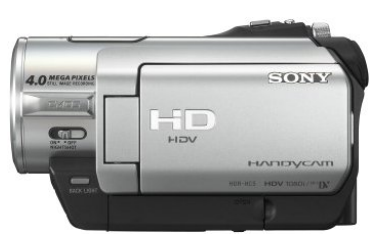
Sony HDR-HC5 1080i HD Handycam Camcorder for 2007
Overview
HDV was designed to offer an upgrade path from standard-definition (SD) to high-definition (HD) video. Since HDV operates at the same recorded datarate (25 Mbit/s) as DV, HDV recorders share the same physical tape transport (Mini-DV). HDV camcorders open high-definition video to consumers, amateur videographers, and low-budget TV production.
Although 1080i HDV and DV share the same (DV) tape format and the same recorded datarate, they use completely different video compression technology. The DV codec uses strictly an intraframe scheme, whereas HDV uses the MPEG-2 video codec. MPEG-2 applies both intraframe and interframe to video-compression, allowing HDV to achieve its higher spatial resolution at the target bitrate of 19.7 Mbit/s (720p) and 25 Mbit/s (1080i).
HDV audio uses lossy compression (MPEG-1 Layer 2) to reduce the audio bitrate to 384Kbps. DV audio uses uncompressed 16-bit PCM at 1536Kbps. As a result, HDV audio is technically inferior, although MPEG-1 at 384Kbps is regarded as 'perceptually lossless.'
Since HDV and Mini-DV use the same DV25 tape transport, at the same linear speed, recording times for DV and HDV are identical. That is, a 60 minute Mini-DV cassette can store 60 minutes of either Mini-DV or HDV footage.
As of yet, no HDV cameras can record HDV at LP speed, so the maximum record time on one tape is 80 minutes, as opposed to 120 with an 80 minute tape at LP. Because HDV uses the same tape form factor as DV, users should be able to use any high quality Mini-DV tape in their HDV camcorder. However, because HDV has a lower tolerance for drop-outs because of its long-GOP compression, many HDV users purchase either "master" quality Mini-DV tapes or specially formulated HDV tapes.
HDV compression
Although HDV and DV share the same tape format and the same recorded datarate, they use completely different video compression technology. The DV codec is strictly an intraframe (spatial) compression. Each DV video frame is recorded as an independent picture, with a fixed bit allocation and uniform placement on the videotape. The HDV codec is based on MPEG-2 video compression, which employs both intraframe and interframe (temporal) techniques. Interframe compressors store only a fraction of the frames in a video as independent pictures -- called I frames -- and encode the remaining frames as changes relative to them. Consequently, HDV frames vary in size depending on their prior and future neighbors. In HDV 1080i, one in every 12 (25 FPS) or 15 (30 FPS) frames is an I frame.
MPEG-2 video enables HDV to achieve a much higher compression ratio than DV, but at the cost of motion-induced artifacts in scenes of complex motion. The artifacts are a limitation of the compression technology and bitrate allocated to the video bitstream. Encoders are constantly improving; The Sony XDCAM HD format is very similar to HDV.
Resolution and aspect ratio
In HDV, the video frame is defined to have an aspect ratio of 16:9. Permitted resolutions are 720p and 1080i.
• HDV 720p uses a resolution of 1280x720 square pixels.
• HDV 1080i uses a resolution of 1440×1080 pixels,
but is still displayed with an aspect ratio of 16:9 (like SD widescreen formats, it uses a pixel aspect ratio of 1.33 instead of 1.0).
This means it has lower horizontal resolution than true 1080 HD formats (1920x1080). HDV resolution, while falling short of true 1080 HD, is still much higher than that of standard DV. 1440 pixels is still twice the horizontal resolution of SD formats.
In total, each HDV frame has 1,555,200 pixels, which is 4.5 times the resolution of NTSC DV (345,600 pixels) and 3.75 times that of PAL DV (414,720 pixels).
The numbers above refer to the luminance (brightness) information only; chrominance (color) information is subsampled (4:2:0 for HDV) to reduce the amount of data, as happens with DV and DVD, although NTSC DV uses a different sampling pattern (4:1:1). In other words, in all these formats, the chrominance resolution is one quarter of the luminance resolution. Most professional video formats use a 4:2:2 sampling pattern, and some high-end formats support 4:4:4, which is to say full chroma sampling.
Editing HDV
As a consequence of the fact that HDV uses the interframe MPEG-2 GOP (group of pictures) structure instead of a solely intraframe compression system, native editing of HDV footage differs technically from the native editing of DV footage. In DV, as each frame of a video sequence is stored as an independent object, the recorded footage can be spliced at any frame without any loss of quality. When editing HDV's MPEG-2 data directly, a single frame cannot be changed without re-encoding subsequent frames from the same group. Any editing of the native MPEG-2 video, whether it be a complex transition or a simple scene-change, requires a decompression and recompression of the entire HDV frame group. Especially over many generations, this may result in increased artifacting.
HDV's 1080i bitrate is 25 Mbit/s. Editing HDV's native MPEG-2 transport stream files also forces the computer system to work much harder to perform even simple tasks of cutting and splicing as frames that don't actually exist as independent cells have to be re-built.
Avid Xpress Pro can edit using native HDV.
JVC
In 2003,
JVC introduced the GR-HD1, a $2,500 HD camcorder
geared specifically for enthusiasts who
want to create high-quality widescreen videos to
playback on their new High Definition
TVs.
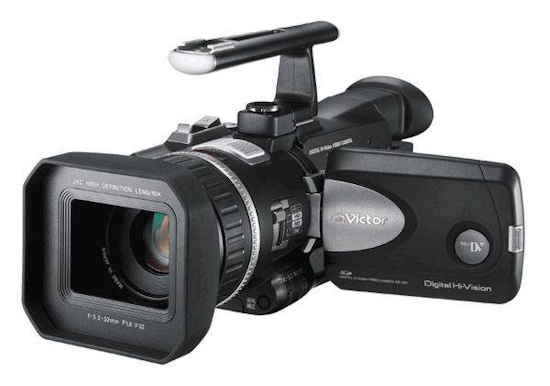
JVC GR-HD1 CAMCORDER
The format is officially called
HDV and it records high-definition video on
blank Mini DV cassettes. HDV backers also
include Canon, Sharp and Sony. The four proposed
the basic specifications for the format in July
2003 and received support from many companies.
The final specifications for the HDV format
became available in October 2003.
JVC was the first to release an HDV
camcorder, the GR-HD1. With the GR-HD1, the user
could select standard-DV (480i), or HDV (720p30,
480p60) mode.
Sony was next to launch an
HDV camcorder. Introduced in Sept 2004, the
Sony HDR-FX1 recorded in HDV 1080i
format. Depending on the TV-standard in the
released market, the unit would support either
50Hz or 60Hz recording (but not both.) The Sony
HVR-Z1U, the equivalent professional model,
supports both and adds XLR audio plus about 25
more features.
These cameras were all
expensive and not really intended for the
average consumer. But in 2005, Sony released the
consumer-oriented HDV Camcorder, the Sony
HDR-HC1 and in 2006, the Sony
HDR-HC3 . In 2006, Sony replaced the
HDR-HC1 with the less-expensive HDR-HC3. The HC3
features a slightly improved CMOS chip, but
omits some features (such as external mic-in) of
its predecessor. In 2007, the Sony
HDR-HC5 and HDR-HC7 were
released.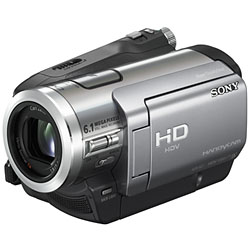
Sony HDR-HC7 HDV
camcorder for 2007
SONY

2005 SONY HDR-HC1
CAMCORDER
Sony
HDR-HC1
Features:
- HDV 1080i camcorder features HDV, DV (on a
standard MiniDV cassette), and SD recording
- 1/3-inch CMOS sensor with 3.0-megapixel
still-image resolution
- 10x optical zoom lens (digital zoom to 120x)
and Super SteadyShot Image Stabilization
- 2.7-inch wide (16:9) Hybrid Touch Panel
Swivelscreen LCD; 37mm Carl Zeiss Vario-Sonnar
T* lens
Specifications
| Imaging device: |
1/3-inch 3000K pixel CMOS sensor |
| Viewfinder: |
Color, precision 16:9 (252K pixel) |
| Video actual: |
1983K pixels (16:9); 1486K pixels
(4:3) |
| Still actual: |
50-590mm (camera; 4:3 mode); 40-400mm
(memory; 16:9 mode); 37-370mm (memory; 4:3
mode) |
| Aperture: |
1.8-2.1 |
| Focal distance: |
5.1 to 51mm |
| 35mm conversion: |
41 to 480 millimeters (camera; 16:9
mode) |
| Filter diameter: |
37mm |
| Optical zoom: |
10x |
| Digital zoom: |
120x |
| Carl Zeiss lens: |
Yes, Vario-Sonnar T lens |
| Focusing: |
Full Range Auto/Manual (Ring)/One
Touch |
| SteadyShot Image Stabilization: |
Yes, Super Steadyshot |
| Minimum illumination: |
7 lux |
| NightShot Infrared System: |
Super |
| Shutter speed: |
1/4 to 1/10,000 second (in AE
Mode) |
| LCD: |
2.7-inch-wide (16:9) Hybrid Touch Panel
SwivelScreen (123k) |
| Accessory shoe: |
Active interface shoe |
| Video input/output: |
Yes/yes (multi) |
| Audio input/output: |
Yes/yes (stereo, multi) |
| i.LINK2 DV interface (IEEE1394): |
Yes |
| USB port(s): |
Yes, ver. 1.1 |
| USB streaming: |
N/A |
| Headphone jack: |
Yes (stereo, mini) |
| Microphone input: |
Yes (stereo, mini) |
| White balance: |
Auto/Outdoor/Indoor/One-Push |
| Iris control: |
Automatic |
| Power consumption (VF/LCD/VF+LCD): |
5.8W/5.9W/6.4W (VF/LCD/VF and LCD), HDV;
5.2W/5.3W/5.8W (VF/LCD/VF and LCD), SD |
Dimensions
(W x H x D): |
2 7/8 x 3 3/4 x 7 1/2 inches
(71 x 94 x 88
millimeters) |
| Weight: |
1 pound 7 ounces (without tape or
battery) |
| What's in the Box: |
HDR-HC1 HDV 1080i Handycam Camcorder, power
adaptor/in-camera charger (AC-L15), InfoLithium
rechargeable battery (NP-FM50), wireless remote
commander remote control (RMT-831), lens hood,
lens cap, AV cable, component video cable, USB
cable, shoulder strap, 16MB Memory Stick Duo
Media |
see also: SONY
HDR-HC3
Sony HDR-FX1
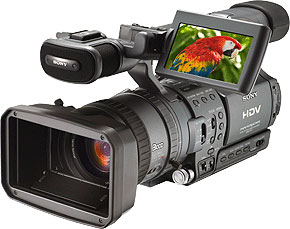
2004 SONY
HDR-FX1 CAMCORDER
The SONY HDR-FX1 HDV
Handycam® Camcorder was introduced with an
initial price of $3,699.99 and was
the world’s first consumer 1080i
high definition camcorder.
- 1080i high definition video recording and
playback
- 3 - 1/3" wide aspect ratio Advanced HAD™ CCD
imagers for enhanced color quality
- Professional-level MPEG2 video compression
with the Real-time HD Codec Engine
- Carl Zeiss® Vario-Sonnar® T* lens with 12x
optical zoom
- 3.5" wide precision hybrid SwivelScreen™ LCD
display
The world’s first consumer 1080i
high definition camcorder, the Sony Handycam®
HDR-FX1. The HDR-FX1 allows you to play and
record interlaced high definition video at
resolutions up to 1440 x 1080 for professional
quality video with vivid colors and striking
detail. It even offers the ability to switch to
standard DV recording and playback as the
situation warrants.
The HDR-FX1 features the Real-time HD Codec
Engine, which offers professional-level MPEG2
video compression, and 14bit HD DXP (Digital
Extended Processor) for increased processing
speed. Images are captured on three chip
Advanced HAD™ CCD system that provides increased
detail and improved video performance without
the color bleeding found in other system.
Optical capabilities include a Carl Zeiss®
Vario-Sonnar® T* lens with 12x optical zoom and
Super SteadyShot® image stabilization.
The HDR-FX1 offers an unprecedented amount of
control to the user, including manual zoom,
focus, and iris control. Picture Profile™ allows
the user to create a number of preset video
modes for a variety of shooting settings.
Composing shots is easier than even with the
3.5" precision hybrid SwivelScreen™ LCD display
and the extra-large electronic
viewfinder.
3-1/3" 16:9 Advanced HAD™ CCD
Imagers 1,120K Pixels Gross
Advanced
HAD™ (Hole Accumulation Diode) CCD imagers with
1,120K effective (video) pixels provides
excellent detail and clarity with exceptional
digital video performance. Using a 3 chip
Advanced HAD™ CCD system and dichroic prism to
separate color information, colors are extremely
accurate, and color “bleeding" and “smearing"
are greatly reduced. |
Advanced HAD™ CCD
Technology
Enhanced CCD design allows
more light to reach the imager which reduces
video noise to improve signal-to-noise ratio by
up to 6db (2x better than a standard CCD).
Particularly effective when shooting in dark
situations. |
HDV Recording Format
From
the innovators in camcorder technology, Sony’s
HDR-FX1 camcorder is the world’s first HDV1080i
consumer level camcorder and player. Now you can
record all your memories in true high-definition
video. |
Switchable HDV/DV Format
Recording
The HDR-FX1 is capable of
recording and playing back both High Definition
and Standard Definition video recorded on
standard MiniDV cassettes. |
Real-time HD Codec
Engine
A Sony developed Real Time MPEG
Encode/Decode system with reduced in energy
consumption and compact size to fit inside a
personal camcorder. Provides efficient MPEG2
compression, and recording and playback of clear
HD images at the same bit rate of the DV format,
so that High Definition video can be recorded on
the same cassettes as are used for MiniDV
recording. |
12X Optical Carl Zeiss®
Vario-Sonnar® T* Lens
From the
authority in lens technology, the Carl Zeiss®
Vario-Sonnar® T* lens provides a high quality
12x optical zoom which maintains image clarity
and color while reducing glare and
flare. |
3.5" Wide Precision Hybrid
SwivelScreen™ LCD Display
1 (250K
Pixels)
Provides excellent viewing
clarity with improved resolution. The 250K pixel
LCD display makes images sharp and detailed
during playback or when monitoring recording.
The Hybrid Reflective-Transmissive LCD Screen
provides accurate viewing in sunlight or bright
light, virtually eliminating the “wash-out"
common with traditional LCD
Screens. |
Super SteadyShot® Optical
Stabilization System
An advanced form
of Sony’s SteadyShot Image Stabilization system
that controls an even higher range of shake and
vibration frequencies. This optical
stabilization system achieves an even higher
level of smoothness without degradation of video
like some digital stabilization
systems. |
Analog/Digital Conversion with
Pass-Through
Convert and/or record any
analog NTSC video source to digital video via
the analog inputs. Analog NTSC video can also be
passed through the digital Handycam camcorder
directly into a PC via the i.LINK® interface in
real-time for easy PC editing of your analog
footage. |
Manual Zoom and Manual Focus
Ring
Dual independent Zoom and Focus
rings provide precise and detailed control over
the amount of zoom and the overall focus of the
image with just a turn of the rings. Fast,
intuitive framing when zooming, and finely
detailed focusing is easy with the natural
“feel" of the rings. |
Expanded Focus
Indicator
The camera‘s LCD image is
magnified, temporarily, up to 4X its original
size without any loss of distortion. This allows
the user more finite control while focusing the
camera for greater detail and
clarity. |
Picture Profile
Allows
the user to set manual adjustments for a scene
(color, sharpness, white balance, etc) into any
one of six presets, so they can be called up at
just the touch of a button. Useful when shooting
under the same conditions repeatedly, as options
do not have to be re-set each time. Settings for
various shooting conditions are offered as
defaults. |
CineFrame™
Recording
Provides the option of
recording video at either 30 fps or with a
feeling of “film-like" 24 fps. |
Assignable Buttons
Three
buttons on the exterior of the camcorder are
user-assignable so that they can be set to the
options most commonly utilized, for ease of
recording. |
i.LINK® DV Interface
(IEEE1394)
A high speed bi-directional
digital video/audio communication between two
compatible devices equipped with an IEEE1394
interface, including camcorders, digital VCRs,
and PCs. |
MPEG 1 Audio Layer
II
The HDR-FX1 records audio in MPEG1
Audio Layer II while recording in HDV format
that provides outstanding sound quality even
when compressed. In the standard DV format audio
is recorded in either 12/16 bit (selectable) PCM
Digital Stereo for audio quality that rivals
that of a CD. |
Manual Iris Control
By
turning the Iris dial on the side of the camera,
the user can manually adjust the amount of light
entering the camera. The iris is adjustable from
f1.6 to f11, in 24 steps. |
Shot Transition
Allows
for a smooth automatic scene transition.
Settings for focus, zoom, iris, gain, shutter,
and white balance can be set to the A/B button
and a smooth transition will take place
according to the set time. This function enables
the focus to gradually shift from the front of
the screen to a deeper part of the screen. Thus
the iris enables a smooth change of depth of
field. |
SONY HDR-FX1
Specifications
| • Imaging Device: 3- 1/3" 16:9
1120K Pixel Advanced HAD™ CCDs |
| • Video Actual: 1070K
Pixels |
| • F: 1.6 – 2.8 |
| • Focal Distance: 4.5 –
54.0mm |
| • 35mm Conversion: 32.5 –
390mm |
| • Filter Diameter: 72mm |
| • Optical Zoom: 12X |
| • Focusing: Full Range
Auto/Manual (Ring) / One Touch |
| • Minimum Illumination: 3
lux |
| • NightShot® Infrared System:
N/A |
| • Shutter Speed: 1/4 – 1/10,000
(in AE Mode) |
| • Viewfinder: Color, Precision
16:9 (252K pixel) |
| • LCD: 3.5" 16:9 (250K) Precision
Hybrid Color1 |
| • Accessory Shoe: Yes
(Cold) |
| • Video Input/Output: Yes
(Composite (Mini) and S-Video/Yes (Component,
Mini, and S-Video) |
| • Audio Input/Output: Yes/Yes
(Stereo, Mini) |
| • i.LINK®2 DV
Interface (IEEE1394): Yes |
| • USB: N/A |
| • USB Streaming: N/A |
| • Headphone Jack: Yes (Stereo,
Mini) |
| • Mic. Input: Yes (Stereo, Mini) |
| • White Balance: Auto/One-Push
(A)(B)/Preset |
| • Iris Control: Yes, Gain
Independent |
| • Power Consumption
(VF/LCD/VF+LCD): 7.4W / 8.0W / 8.4W |
| • Dimensions (WHD): 6" x 7 1⁄8" x
14 3⁄8" |
| • Weight: 4 lbs 4 oz |
• Supplied Accessories:
AC-L15
Power Adaptor/ In Camera Charger, NP-F570
InfoLithium® Rechargeable Battery, RMT-831
Wireless Remote Commander® Remote Control, AA
Battery, Lens Hood, Lens Cap, Multi A/V Cable,
Component Video Cable, Cleaning Cassette, Shoe
Adapter, Large Eye Cup, Shoulder
Strap |
Canon HV20 HDV Camcorder
HDV
HDV Tapes: Sony Digital HD Video
Tape Cassette for HDV & MiniDV. High
Definition Video Recording/ Designed For 1080i
or 720p HDV.

Sony’s DVM-63HD HD DVC
tape offers the highest quality recording media.
It is the recommended media for Sony's HDR-FX1
camcorder. It has a 63 minute tape
duration.
High Definition Video
Recording. Designed for 1080i or 720p HDV
recording and playback. 63 minutes recording
time of 1080i video 3dB higher carrier-to-noise
ratio vs. Premium DVC tape. Conforms to the
MiniDV standard, yet is manufactured with much
higher tolerances while incorporating the new
AME II technology.
The additional
3-minutes on the DVM63HD tape is for test
recording. This helps the user calibrate the
camera for best results. You can record the full
63 minutes of 1080i video. When recording in
720p HDV or in DV mode, you can record 94 min in
LP and 63 min in SP setting.
Since HDV operates at the same recorded
datarate (25 Mbit/s bitstream rate) as DV, HDV
recorders share the same physical (MiniDV )
tape-transport as existing DV equipment. For the
camera, the main expense is concentrated in the
optics and imaging electronics. Compared to
HD-video equipment built on more professional
standards (such as HDCAM and DVCPROHD), HDV
enjoys a tremendous cost advantage.
HDV-camcorders opens high-definition video
acquisition to consumers.
| Media |
|
VIDEO |
|
| Video signal |
480/30p, 480/60p, 576/25p, 576/50p, 720/60p,
720/30p, 720/50p, 720/25p, 1080/60i, 1080/50i,
1080/25p, 1080/30p |
| Video Chroma subsampling |
4:2:0 |
| Video sample quantization |
8 bits (both luma and chrominance) |
| Video Compression |
MPEG2 Video |
| Video compressed bitstream rate |
Approximately 25 Mbit/s for 1080i / 19
Mbit/s for 720p |
|
AUDIO |
|
| Audio sampling frequency |
48 kHz |
| Audio quantization |
16 bits |
| Audio compression |
MPEG-1 Audio Layer II |
| Audio compressed bitstream rate |
384 kbit/s |
| Audio mode |
Stereo (2 channels); optional 4-channel
synchronous |
| Media |
Same as DV format (DV
and/or Mini DV Tape) |
| Video |
| Video Signal |
720/60p, 720/30p
720/50p,
720/25p |
1080/60i, 1080/50i |
| Number of Pixels |
1280 X 720 |
1440 X 1080 |
| Aspect Ratio |
16:9 |
| Compression |
MPEG2 Video (profile
& level: MP@H-14) |
| Sampling Format |
4 : 2 : 0 |
| Quantization |
8 bits (both
luminance and chrominance) |
| Bit rate after Compression |
Approximately 19Mbps |
Approximately 25Mbps |
| Audio |
| Compression |
MPEG1 Audio Layer
II |
| Sampling Frequency |
48kHz |
| Quantization |
16 bits |
| Bit rate after Compression |
384kbps |
| Audio Mode |
Stereo (2
channels) |
| System |
| Data Format |
MPEG2 |
| Stream Type |
Transport Stream |
Packetized Elementary
Stream |
| Stream Interface |
IEEE-1394
(MPEG2-TS) |
| HDV CAMCORDERS |
 |
 |
1. HDV - SONY HDR-HC7 for 2007. The HDR-HC7 consumer-grade, dual-mode HDV/DV camcorder was announced by Sony at the annual Consumer Electronics Show (CES), held January 8 thru 11, 2007, in Las Vegas, Nevada. The HDR-HC7 has a U.S. MSRP of $1399.99 and became available in February 2007.
The HDR-HC7 has a single 1/2.9-inch (0.3448-inch) ClearVid CMOS (Complementary Metal Oxide Semiconductor) sensor, a 2.7-inch 211,200 dot widescreen 16:9 aspect ratio LCD panel, uses Sony's Super SteadyShot OIS (Optical Image Stabilization) system, and is equipped with an F1.8-2.9 40 mm to 400 mm 10x optical (20x digital) zoom lens that offers manual focus. Minimum illumination is specified as 2 lux (1/30) and the lens accepts 37 mm diameter attachments/accessories.
The HDR-HC7 has a bi-directional 4-pin S100 mode (98.304 Mbps) IEEE 1394a (aka Apple FireWire 400 / Sony i.LINK) port, a Mini-B USB 1.1 port, YPbPr analog component video output, a 19-pin Type A HDMI (High-Definition Multimedia Interface) output jack, a built-in stereo microphone plus an unbalanced microphone input jack, a headphone output jack, includes PictBridge support for direct-to-printer printing, and weighs approximately 22 ounces with a tape and the supplied NP-FH60 battery. Other batteries that can be used with the HDR-HC7 are the NP-FH50, the NP-FH70, and the high-capacity NP-FH100. Although it's possible to change tapes in the HDR-HC7 while the camcorder is tripod-mounted, positioning of the battery release lever on the underside of the unit requires that the camcorder first be removed from the tripod.
The HDR-HC7 has a LANC (Local Application Control or Control-L) control jack, but lacks an analog-to-digital pass-through capability. The camcorder is equipped with a built-in flash for shooting still images and, as with most camcorders in its range, has the ability to shoot still images while simultaneously shooting video. Still image storage is to Memory Stick Duo and Memory Stick PRO Duo (4 GB max) flash memory cards. Memory Stick and Memory Stick PRO media cannot be used with the camcorder. The HDR-HC7 implements Sony's proprietary AIS (Active Interface Shoe) technology that provides power to externally-attached accessories such as a video light or powered microphone.
The HDR-HC7 can be used with Sony's SPK-HCC underwater housing (Sports Pack), which is waterproof to a depth of 17 feet (5 meters). This U.S. MSRP $249.99 optional accessory, which has a built-in stereo microphone, became available in February 2007.
|
|
|
|
2. HDV - SONY HDR-HC5 for 2007. The HDR-HC5 has a single 1/3-inch (0.3333-inch) ClearVid CMOS sensor, a 2.7-inch widescreen 16:9 aspect ratio LCD panel, uses an EIS (Electronic Image Stabilization) system, and is equipped with an F1.8-2.9 41.3 mm to 485 mm 10x optical (80x digital) zoom lens that offers manual focus. Minimum illumination is specified as 2 lux (1/30) and the lens accepts 37 mm diameter attachments/accessories.
The HDR-HC5 has a bi-directional 4-pin S100 mode (98.304 Mbps) IEEE 1394a (aka Apple FireWire 400 / Sony i.LINK) port, a USB 1.1 port, YPbPr analog component video output, a 19-pin Type A HDMI (High-Definition Multimedia Interface) output, a built-in stereo microphone, includes PictBridge support for direct-to-printer printing, and weighs approximately 21 ounces with a tape and the supplied NP-FH60 battery. The HDR-HC7 has a LANC (Local Application Control or Control-L) control jack, but lacks an analog-to-digital pass-through capability and has neither a microphone input jack nor a headphone output jack.
|
|
|
 |
3. HDV - SONY HDR-HC3 for 2006. The Sony HDR-HC3 is a dual-mode HDV/DV camcorder with a single 1/3-inch CMOS (Complementary Metal Oxide Semiconductor) sensor intended for the point-and-shoot segment of the consumer market. It's both smaller and lighter, by about 26 percent, than the HDR-HC1 and has a highly-automated "Easy Handycam" mode of operation. The CMOS sensor employs Sony's ClearVid technology, which makes it more sensitive than the sensor used in the older model HDR-HC1 camcorder.
The HDR-HC3 has a Carl Zeiss Vario-Sonnar T* lens with a 10x optical zoom and 20x and 80x digital zoom modes, a 2.7-inch 16:9 aspect ratio LCD (Liquid Crystal Display) touch screen display with 211,200 dots, a built-in flash, a built-in speaker, supports Sony's NightShot and Super NightShot modes, and includes an AC adapter and a lithium-ion battery. Power consumption is less than that of the HDR-HC1 and unlike the HDR-HC1, the HDR-HC3 is not bottom-loading; the tape transport mechanism on the HDR-HC3 is located on the side of the camcorder—although the battery release lever is located on the underside of the unit near the tripod mount. The camcorder has a Sony AIS (Active Interface Shoe) that can be used to supply power to optional accessories such as a video light, a photo flash, or an external microphone, although the HDR-HC3 lacks an input jack for connection of an external mic, so only an AIS-compatible microphone such as the Sony ECM-HGZ1 shotgun can be used. There's also no headphone jack provided on the unit.
The fixed lens accepts 30 mm diameter attachments/accessories. The HDR-HC3 employs an EIS (Electronic Image Stabilization) system.
The HDR-HC3 includes a Memory Stick slot that accepts both Memory Stick Duo and Memory Stick PRO Duo flash memory cards and which can be used to store JPEG still images at a number of different resolutions. Usable Memory Stick PRO Duo media is limited to 2 GB in size. Also included on the camcorder are a 4-pin IEEE 1394a (aka Apple FireWire 400 / Sony i.LINK) port operating in S100 mode (98.304 Mbps) for computer transfer of both DV and HDV datastreams and a Mini-B USB port for computer still image transfer and for connection to PictBridge-compliant printers such as the Sony DPP-FP50 Digital Photo Printer for direct-to-printer printing. Still images can be saved to Memory Stick media while the camcorder is recording live video to tape, although the built-in flash is disabled during tape recording.
The HDR-HC3 can perform DV-mode tape recording at SP and LP (Standard Play and Long Play, respectively) speeds and in traditional standard 4:3 or special widescreen 16:9 aspect ratios, while 2-channel stereo DV audio can be captured at user-selectable bit depths and sampling rates of 12/32 or 16/48. JVC-style 720p HDV tape recordings can be played by the HDR-HC3, but no signal is output via the camcorder's IEEE 1394a connector when playing back such tapes.
The HDR-HC3 has a 2.5 mm LANC jack, built-in HDV to DV downconversion capability, analog component video (YPbPr) output, an A/V connector which supplies composite video, S-Video (Y/C), and audio, and a 19-pin Type A HDMI output jack. All of the camcorder's SD (standard definition) functions are NTSC-based. Whether recording in DV mode or in HDV mode, any blank DV tape can be used in the HDR-HC3, although tapes having the Cassette Memory feature cannot be used. Recommended head cleaning cassette is the Sony DVM-12CLD. The HDR-HC3's viewfinder is designed to be user-removable with a screw driver for cleaning purposes, an unusual feature on a consumer-grade camcorder.
A variety of battery packs can be used to power the HDR-HC3 including the NP-FP50, NP-FP60 (supplied), NP-FP70, NP-FP71, and NP-FP90, although the NP-FP30 cannot be used with this camcorder. The camcorder can be used with the Sony SPK-HCB underwater housing (Sports Pack), which is waterproof to a depth of 17 feet (5 meters), making it useful for snorkeling but not for serious diving.
(U.S. MSRP $1499.99)
|
|
 |
4. HDV - SONY HDR-HC1 for 2005. The Sony HDR-HC1 is a 1/3-inch single CMOS (Complementary Metal Oxide Semiconductor) sensor based, consumer-grade, dual-mode HDV/DV camcorder and is smaller and lighter than the older model HDR-FX1. This camcorder has a Carl Zeiss zoom lens (10x optical and 120x digital) with zoom ring, 2.7-inch touch-panel LCD (Liquid Crystal Display) screen, spot focus, built-in pop-up flash, YPbPr analog component video output, SD (standard definition) downconversion, 4-pin IEEE 1394a (aka Apple FireWire 400 / Sony i.LINK) and USB connections, both manual focus and auto focus, can store stills on Sony Memory Stick Duo/Memory Stick PRO Duo media, supports an infrared low-light/no-light shooting mode, includes PictBridge support for direct-to-printer printing, and weighs approximately 1.5 pounds less battery. All of this camcorder's SD functions are NTSC-based.
The fixed lens accepts 37 mm diameter attachments/accessories.The HDR-HC1 employs an EIS (Electronic Image Stabilization) system, rather than an OIS (Optical Image Stabilization) system.
Recommended cassette tape for use with the HDR-HC1 camcorder, especially when operated in HDV mode, is the Sony DVM-63HD. This is the same tape that Sony recommends for use with the HDR-FX1.
The HDR-HC1's tape transport mechanism is bottom-loading. The battery release switch is also located on the underside of the unit.
Initial availability was July 15, 2005 with a U.S. MSRP of $1999.99.
|
|
|
 |
5. HDV - Canon HV10 for 2006. Captures 1080 High Definition resolution video in 16:9 format using Mini-DV cassette tapes. CMOS sensor, DV/HDV.
CANON HV10 Digital zoom 200 x Effective sensor resolution 2.96 megapixels Optical sensor size 1/2.7 in Optical sensor type CMOS
Shooting modes Normal movie mode, Digital photo mode White balance Presets, Automatic White balance presets Shade, Cloudy, Daylight, Tungsten light, Fluorescent light (cool white), Fluorescent light (warm white)
Widescreen video capture Yes
Lens aperture F/1.8-3.0
Optical zoom 10 x Lens system type Zoom lens
Min focal length 6.1 mm Max focal length 61 mm
Filter size 37 mm Manual focus Manual, Automatic Min focus range 0.4 in Zoom adjustment Motorized drive
Memory / StorageMedia type Mini DV
Viewfinder / DisplayDisplay type LCD display - - 2.7 in - Color Display form factor Rotating Display resolution 210,000 pixels Viewfinder color support Color
Expansion / Connectivity
Connections 1 x Additional Features
Video input features RGB primary color filter
Software type Roxio My DVD, Canon PhotoStitch, Canon ImageBrowser, Drivers & Utilities, Canon ZoomBrowser EX
Power supply included Power adapter -
External Physical Characteristics
Width 2.2 in Depth 4.2 in Height 4.1 in Weight 15.5 oz |
|
|
 |
6. HDV - Canon HV20 for 2007. HDMI port, better low-light performance than HV10. MSRP of $1099.99 |
High Definition video recorded on DVD and HDD.
In
addition to recording HD on tape, you can now
record HD on mini-DVD, hard disk drive (HDD) and memory card camcorders. Using
AVCHD with MPEG-4 compression and dual-layer 8cm
DVD, you can get High-Def video on a consumer
level camera. But be careful regarding
compatibility. Not all devices will playback
this format and not all video editors have come
up to speed yet to be able to edit this format.
What is AVCHD?
AVCHD (Advanced Video Codec High
Definition) is a new high definition recording
format introduced by Sony and Panasonic. It can
use various storage media, including 8 cm (3
inch) recordable DVD discs, as well as hard
disk, and SD and Memory Stick Pro memory cards,
and is being positioned to compete with handheld
video camera recording formats like HDV and
MiniDV.
AVCHD uses an MPEG-4 AVC (H.264)
video codec. AVC's greater compression
efficiency (when compared with the aging MPEG-2
codec used in HDV camcorders) allows AVCHD
recorders to capture video using less storage.
The audio track can be stored as uncompressed
7.1 linear PCM, or compressed AC-3 surround 5.1.
The compressed audio and video data are
encapsulated in an MPEG-4 Transport stream,
called HDMV.
• How to choose a camcorder
• Digital
Camcorders - Digital8
• Digital
Camcorders - MiniDV
• MicroMV,
solid state memory cards
• Digital
Camcorders - DVD
• High-Definition
Camcorders
• Digital
Camcorders - Hard Disk Drive (HDD)
• Camcorder
Connections and Accessories
• Summary
• How to connect camcorder to TV, VCR, HDTV
• How to connect camcorder to PC
• Video Editors for PC and Mac
• Photo Gallery of camcorders
• Camcorder Buying Guide
Columbia ISA Audio Video
Empowering consumers through information
SWS
|